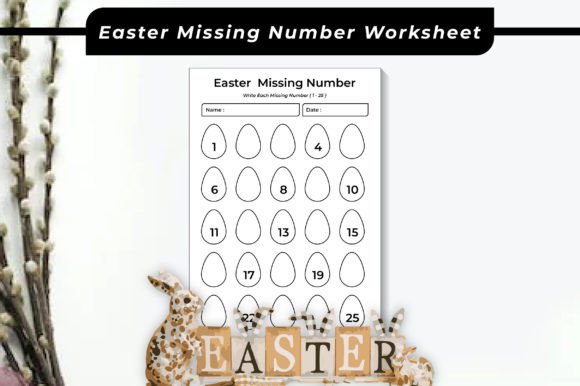
Missing Number Worksheet for 1st Grade
Springtime brings a unique opportunity to blend seasonal joy with essential learning milestones. For educators and parents alike, the challenge often lies in finding resources that capture a child's attention while reinforcing core curriculum standards. A Missing Number Worksheet for 1st Grade themed around Easter offers exactly this balance. It transforms the abstract concept of number sequences into a tangible, engaging activity featuring bunnies, eggs, and spring colors. This approach does more than just fill time; it builds a critical foundation in mathematics by encouraging pattern recognition and logical reasoning in a low-stress environment.
The Educational Value of Seasonal Math Activities
First grade is a pivotal year where students transition from simple counting to understanding the relationships between numbers. They begin to grasp that numbers follow a predictable order, a concept known as sequencing. When a child encounters a sequence like "2, __, 4, 5," they are not merely filling in a blank; they are actively processing the rule that governs the series. Integrating this skill practice into an Easter Themed Missing Number Worksheet leverages the power of context. The familiar imagery of the holiday reduces cognitive load associated with anxiety or boredom, allowing the student to focus entirely on the mathematical task at hand.
Research in early childhood education suggests that thematic learning significantly boosts retention. When math problems are wrapped in a narrative or visual theme, such as an egg hunt or a bunny's garden, the brain creates stronger neural pathways. This makes the Missing Number Worksheet for 1st Grade Students an effective tool for both classroom instruction and homeschooling. It turns a routine drill into an adventure, motivating young learners to complete the sequence to "find" the hidden numbers within the festive illustrations.
Key Features That Drive Engagement
What sets a high-quality printable apart from a generic exercise sheet? The answer lies in the intersection of pedagogy and design. An effective Easter-themed resource includes:
- Visual Consistency: Cute illustrations of bunnies and decorated eggs provide a cohesive aesthetic that keeps the child focused on the page.
- Progressive Difficulty: Sequences should start simple (counting by ones) and gradually introduce slight variations to challenge developing skills without causing frustration.
- Clear Instructions: For first graders who may still be refining their reading skills, visual cues and simple language are essential for independent work.
- Printable Format: High-resolution PDF files ensure that the text remains sharp and the colors vibrant when printed on standard home or office paper.
These characteristics ensure that the worksheet serves its primary function: reinforcing number sense. By completing the missing numbers, students improve their overall math fluency. The act of writing the correct digit solidifies the connection between the symbol and its value in the sequence.
Practical Applications Across Different Environments
The versatility of a Missing Number Worksheet for 1st Grade extends far beyond a single lesson plan. In a traditional classroom setting, teachers can use these printables as morning work, a quick center rotation activity, or a take-home assignment to reinforce the day's lesson. For distance learning scenarios, digital downloads allow parents to easily access materials that align with school curricula, ensuring continuity in education regardless of location.
In a homeschooling environment, these worksheets offer structure and variety. Parents acting as primary educators often seek resources that save preparation time while delivering high-quality content. An Easter Egg Hunt Missing Number Worksheet provides a ready-made activity that requires minimal setup—simply print and go. This efficiency allows families to dedicate more time to interactive discussions about the math concepts being practiced.
For educational bloggers, publishers, and creators, these resources represent a valuable asset. Creating a library of seasonal activities, such as a Printable Easter Missing Number Activity, can drive traffic and establish authority in the niche of elementary education. Professionals in the ed-tech space understand that parents and teachers are constantly searching for fresh, relevant content. Offering a well-designed, holiday-specific resource meets a specific demand during peak search times in the spring season.
Enhancing User Experience and Learning Outcomes
The user experience (UX) of a physical worksheet matters just as much as the content itself. A cluttered page with confusing fonts or distracting backgrounds can hinder performance. Conversely, a clean layout with ample white space and clear, legible numbers supports better concentration. When a student feels successful because the instructions were clear and the visuals were appealing, their confidence grows. This positive reinforcement is crucial for long-term engagement with mathematics.
Furthermore, these activities promote fine motor skills. Writing numbers within designated spaces requires hand-eye coordination and control, which are developmental milestones for six- and seven-year-olds. The combination of cognitive math tasks with physical writing practice makes the Missing Number Worksheet for 1st Grade a dual-purpose tool for holistic development.
Selecting and Implementing Effective Resources
When evaluating a new worksheet, whether for personal use or professional distribution, several factors should be considered. First, verify the alignment with grade-level standards. A first-grade sequence should primarily focus on counting forward and backward within 100, recognizing patterns, and understanding place value basics. If the gaps are too wide or the numbers too complex, the resource becomes ineffective.
Second, consider the adaptability of the material. Can the worksheet be used in different ways? For instance, a teacher might laminate the page and have students use dry-erase markers for repeated practice, reducing paper waste. Or, parents might cut out the numbered eggs and have children physically arrange them in order before gluing them down. This flexibility increases the longevity and value of the resource.
Finally, look for inclusivity. While the Easter theme is specific, the underlying math concepts should be universal. Avoid cultural references that might alienate some students, focusing instead on the universally recognized symbols of the season like eggs and spring flowers. This ensures the activity remains welcoming for all learners in diverse classrooms.
Maximizing Impact with Strategic Use
To get the most out of an Easter Themed Missing Number Worksheet, integrate it into a broader learning strategy. Do not treat it as an isolated event. Instead, pair the worksheet with oral counting games or manipulatives like plastic eggs filled with number cards. This multi-sensory approach caters to different learning styles and deepens understanding.
For business owners and entrepreneurs in the education sector, offering these resources as part of a larger bundle can increase perceived value. Grouping the Easter activity with other spring-themed math exercises creates a comprehensive package that appeals to busy educators looking for semester-long planning solutions. By providing high-quality, thoughtfully designed content, you contribute to the ecosystem of early education, supporting the next generation of mathematicians one number sequence at a time.
Ultimately, the goal is to foster a love for learning. When a child smiles while solving a puzzle involving a bunny and a missing number, they are experiencing the joy of discovery. That moment of "aha!" is what makes resources like the Missing Number Worksheet for 1st Grade so invaluable. It bridges the gap between academic rigor and childhood wonder, proving that education can be both effective and delightful.